“Mama, how many more school days until we get to have another Shakespeare lesson?”
“Why do you have to be such a Puck?”
“It’s Tuesday! You know that what means? Today is our Shakespearean tea!”
Children ages 9, 7, and 5 quoting…
I know a bank where the wild thyme blows,
Where oxlips and the nodding violet grows,
Quite over-canopied with luscious woodbine,
With sweet musk-roses and with eglantine:
There sleeps Titania sometime of the night,
Lull’d in these flowers with dances and delight;
And there the snake throws her enamell’d skin,
Weed wide enough to wrap a fairy in:
And with the juice of this I’ll streak her eyes,
And make her full of hateful fantasies.
These words have been heard rining in my home recently, and it brings the biggest smile to this homeschool mama’s face.
Shakespeare? Really? At Your Children’s Ages?
Well, yes! Let’s give some context… I am an English education major. Now before you think, “Ahh everything makes sense now.” Please know, I had very littled exposure to or interest in Shakespeare, even as an English major. And what little I did know made it feel daunting. Fast forward to this season of motherhood where I am homeschooling my older three children with two toddlers and soon to be a newborn along for the ride. Shakespeare was NOT on my radar as something to add to our schedule.
Then, I read through A Charlotte Mason Companion by Karen Andreola. One of the chapters discusses the beauty of introducing your chidlren to Shakespeare at a young age. Huh? I was intrigued, but skeptical. Funny enough, it was right around that time that I stumbled across these podcast episodes…
- Read Aloud Revival: How To Teach Your Children Shakespeare with Ken Ludwig
- Read Aloud Revival: How To Do Shakespeare (And Actually Enjoy It!)
- Now That We’re A Family: Controversial Subjects We Teach In Our Homeschool
That’s where it all began. I was convinced. Studying Shakespeare would add beauty, richness, and connection to our homeschooling. This could be FUN! My littles could fall in love with the greatest playwright of the English language.
All I had to do was figure out how to dive in.
The Benefits of Shakespeare
Let’s rabbit trail for just a minute before I contine on with the practicals of application. Unless you paused reading this blog to read Andreola’s book and listen to the above mentioned episodes, you are probably not as convinced as I was. While it is not my goal to convince you (do your own research to see if it’s a good fit for your homeschool), I do want to give some of the benefits I found as I was doing my research.
Introducing your young children to Shakespeare…
- Instructs a child’s conscience with ideas of goodness, piety, generosity, courage and love.
- Early instruction keeps an older child from feeling apprehensive to study it later on.
- Expands a child’s vocabulary as they are provided a rich feast of the English language.
- Exposes timless stories and human experiences.
- Shakespeare’s plays help people recognize our own propensity to sin and our need for forgiveness. His plays dispaly human weakness and human emotion.
- Shakespeare’s plays are produced everywhere in the English speaking world. He is known as the world’s most famous playwright, causing his works to be infused into culture. This provides context for cultural and literary references.
- Enhances reading, writing, and critical thinking skills.
- Fosters a lifelong love, engagement, and appreciation for Shakespeare.
Introducing My Children to Shakespeare
Back to figuring out how to dive into Shakespeare… In the podcast episode by Sarah Mackenzie with Read Aloud Revival, she discussed how she would be hosting a “Shakespeare Summer” in her RAR Premium membership. This is a 6 week video course that walks families through the play A Mid Summer Night’s Dream. Since I was a complete newbie, I decided to start there. I thought that getting some outside guidance would give me the direction and tools to launch me into studying Shakespeare. That is what this course has done for us! (more on “Shakespeare Summer” and RAR Premium below)
What a typical Shakespeare lesson looks like for us….
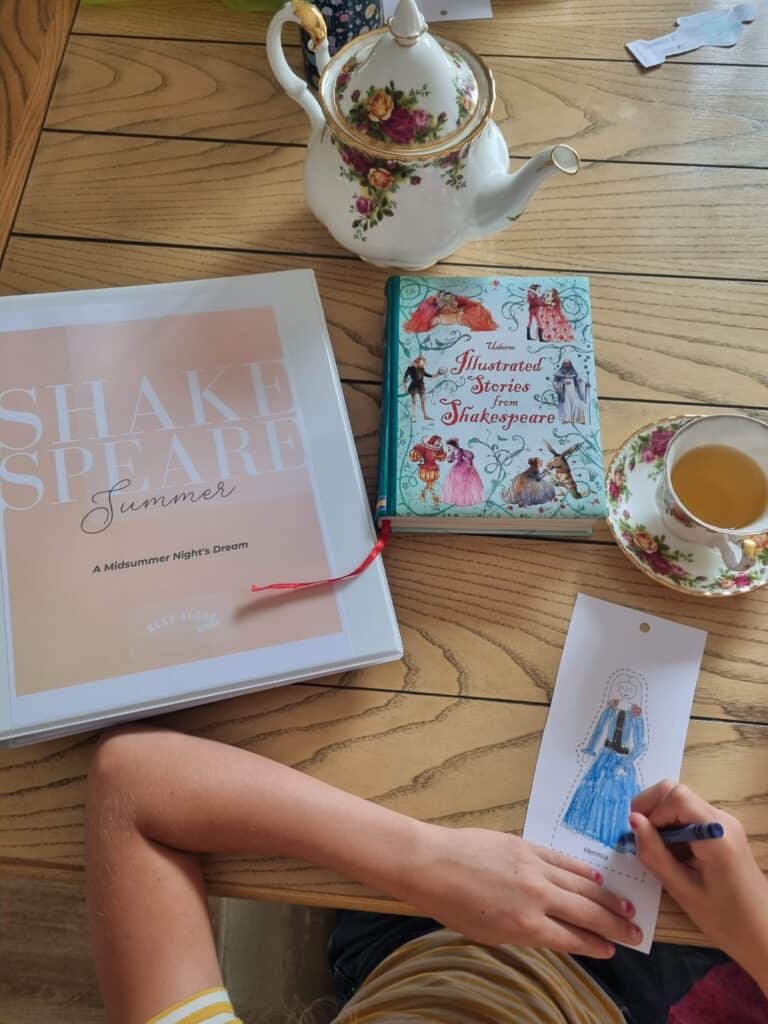
- Our setting: I wanted this experience to be fun and full of family bonding. I know that the way to my children’s hearts is through words, treats, and tea. Hence, our Shakespeare lesson is called our weekly Shakespearean tea complete with my china teapot full of a delicious tea blend, some homemade treat (we’ve done apple walnut muffins, banana bread, and peanut butter chocolate chip balls thus far), and of course, Shakespeare.
- We begin with watching Sarah’s video in the RAR Premium. These are around 20 minutes and dive into the context and vocabulary of each act.
- Next comes our reading of the acts discussed that day. Shakespeare was not meant to be read, it is to be performed! So we put on our best acting voices and read through portions of the act we are studying that day. (This is probably our favorite part of the lesson- outside of tea and treats!)
- We move onto memory work. There are several different suggestions for memorization in Sarah’s course, but we have decided to tackle the section quoted in the paragraph above, “I know a bank where the wild thyme blows…”
- There are a variety of activities listed in the curriculum, but I pick and choose as we go along. We do talk about the discussion questions she lists.
- We finish up with me reading aloud from a version of A Mid Summer Night’s Dream (see resources below). While I read, the kids finish their tea and color a puppet of a character from the story. (see link for puppets below in the other resources section)
How we plan to wrap up our 6 week study of A Mid Summer Night’s Dream…
Sarah’s “Shakespeare Summer” is divided into 6 videos, one for each week of study. By the end of this, I have told the children that their final project will be to quote our passage from memory for Daddy and Mama and to perform a puppet show performing the acts we have read through in school. We still have half of our study to go, but we are all looking forward to our family Shakespeare night!
Where will we go from here?
I am no Shakespeare expert. Studying one of his works for 6 weeks hardly makes me even a novice, but my appetite has been wet. I don’t forsee us stopping here. I do plan for us to move onto our IEW writing course for Term 2, but after baby comes, I think we’ll be onto our next play in Term 3.
Resources
Books:
- How to Teach Your Children Shakespeare by Ken Ludwig
- Tales from Shakespeare by Charles and Mary Lamb
- Shakespeare’s First Folio
- The Story Orchestra: Shakespeare’s A Mid Summer Night’s Dream by Jessica Courtney Tickle
- Usborne Illustrated Stories from Shakespeare
Video Instruction:
- Shakespeare Summer with Sarah Mackenzie: Only available through the RAR Premium subscription (It is a 6 week course, so I signed up for 2 months, then canceled my subscription. I felt it was well worth the cost to give me confidence in where to go with introducing my children to Shakespeare)
Other Resources
- Bluebirds and Blackberries: Lovely coloring outlines and watercolor prints of characters from many of Shakespeare’s stories
Should you choose to purchase these books through the Amazon links I have provided, thank you! They are affiliate links which gives a little back to our family at no extra cost to you! Let us know what games your family enjoys.